Research
Research
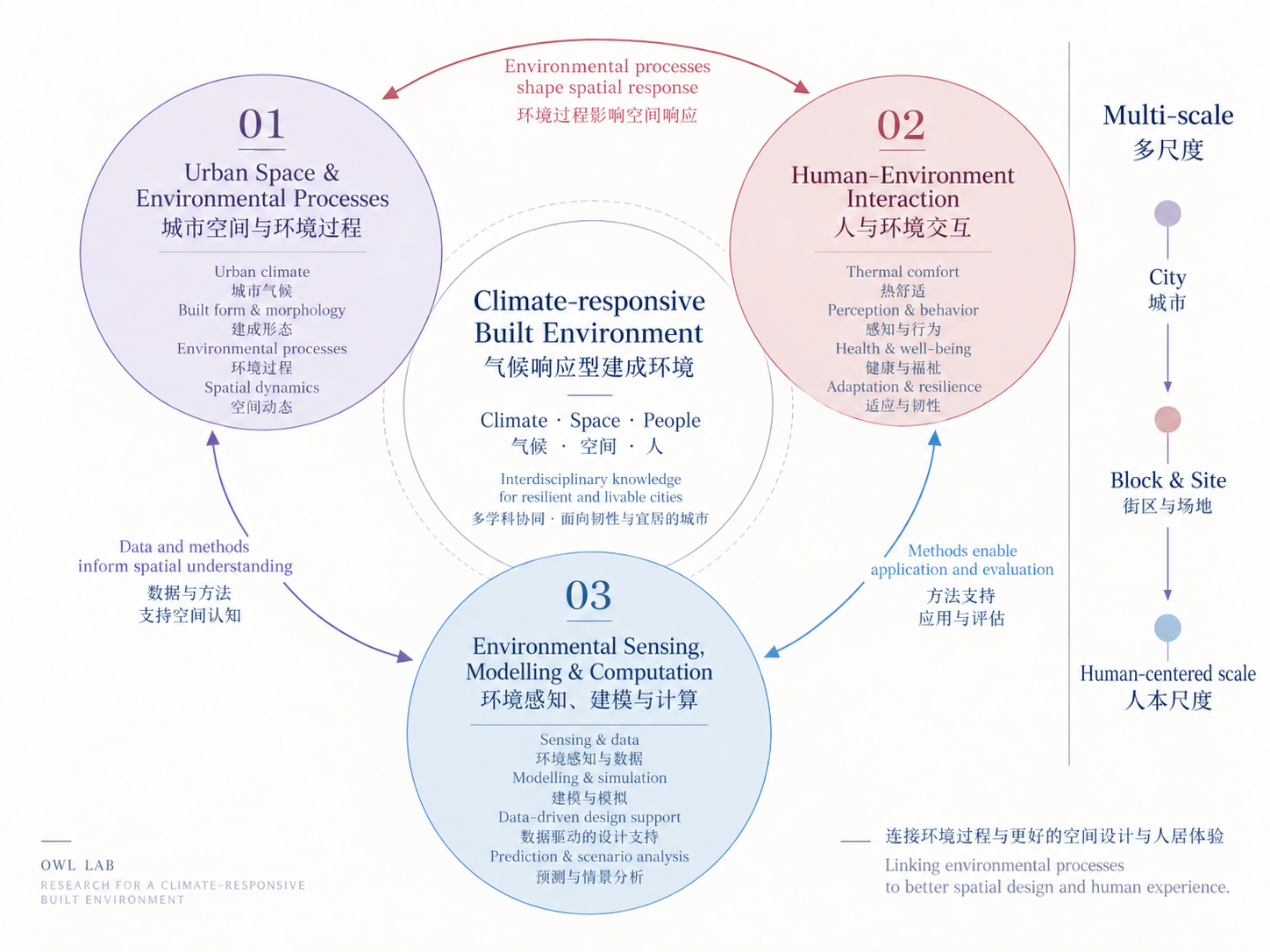
We start from space, trace environmental processes, connect them to people, and bring the resulting knowledge back to design.
Framework
Conceptual framework
1 + 3
Research threads
Urban Space & Environmental Processes
城市空间与环境过程
How do spatial conditions and interventions produce environmental effects, and how do these effects change across time, scale and climate?
Human–Environment Interaction
人与环境交互
How do environmental conditions become human exposure, perception, behavior and health, and how can this knowledge inform spatial design?
Environmental Sensing, Modelling & Computation
环境感知、建模与计算
How can urban environmental processes be sensed, quantified and modelled more accurately and efficiently?
Funded
Funded Projects
The source record provides Chinese titles only; English titles and funding names below are working translations.
Projects led by Owl Lab
Dynamic Thermal Exposure Mechanisms and Spatial Optimisation of New Urban District Streets for Age-Friendly Walking: A Case Study in a Hot-Summer Cold-Winter Climate
Studies dynamic thermal exposure on streets in new urban districts for age-friendly walking in hot-summer cold-winter climates, with implications for spatial optimisation.
Thresholds and Spatial Configuration Methods for Thermal-Environment Improvement through Precision Greening in Urban Block Renewal
Examines thermal-improvement thresholds and spatial configuration methods for precision greening in urban block renewal.
Dynamic Cooling Mechanisms and Optimisation of Urban Blue-Green Spaces Based on Explainable Artificial Intelligence (XAI)
Studies the dynamic cooling mechanisms of urban blue-green spaces and explores optimisation supported by explainable artificial intelligence.
Intelligent Layout and Optimisation Methods for Blue-Green Spaces in Urban Renewal towards Improved Heat Resilience
Develops intelligent layout and optimisation methods for blue-green spaces in urban renewal oriented towards improved heat resilience.
Selected
Selected Publications
01 Urban Space & Environmental Processes
城市空间与环境过程
The cooling efficiency of variable greenery coverage ratios in different urban densities: A study in a subtropical climate.
Ouyang, W., Morakinyo, T. E., Ren, C., & Ng, E. Building and Environment, 174, 106772.
How to quantify the cooling effects of green infrastructure strategies from a spatio-temporal perspective: Experience from a parametric study.
Ouyang, W., Morakinyo, T. E., Lee, Y., Tan, Z., Ren, C., & Ng, E. Landscape and Urban Planning, 237, 104808.
The dual impacts of built environment on extreme heat and urban heat resilience: A comparative study in Beijing.
Liu, Q., Ouyang, W., Tan, Z., Mei, Y., & Bai, B. Urban Climate, 64, 102618.
02 Human–Environment Interaction
人与环境交互
Comparative evaluation of PET and mPET models for outdoor walking in hot-humid climates.
Ouyang, W., Tan, Z., Chen, Y.-C., & Ren, G. Building and Environment, 271, 112636.
The comparative thermal experience of young and old pedestrians in urban green spaces and in densely built areas.
Tan, Z., Christopoulos, G., Roberts, A. C., Ren, G., Ouyang, W., Lo, K., & Ho, C. Urban Forestry & Urban Greening, 105, 128712.
03 Environmental Sensing, Modelling & Computation
环境感知、建模与计算
Evaluating the thermal-radiative performance of ENVI-met model for green infrastructure typologies: Experience from a subtropical climate.
Ouyang, W., Sinsel, T., Simon, H., Morakinyo, T. E., Liu, H., & Ng, E. Building and Environment, 108427.
Comparing Different Recalibrated Methods for Estimating Mean Radiant Temperature in Outdoor Environment.
Ouyang, W., Liu, Z., Lau, K., Shi, Y., & Ng, E. Building and Environment, 109004.